
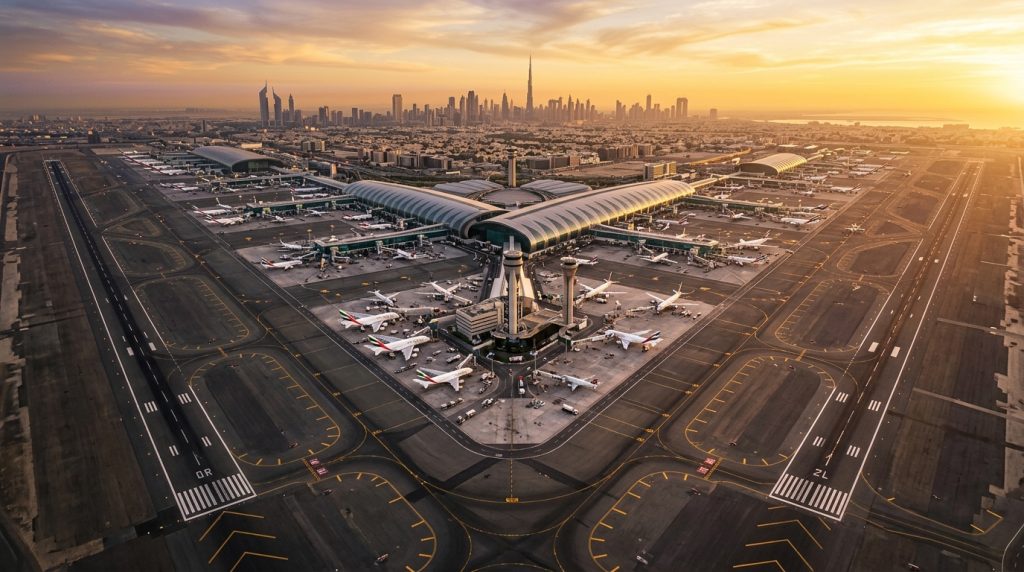
Airports are no longer just utilitarian transit points—they have evolved into self-contained aerotropolises featuring dedicated highways, ecological nature reserves, autonomous transit systems, and even their own postal jurisdictions.
While flyers frequently judge airports by passenger foot traffic or luxury retail terminals, measuring an airport by physical surface land area reveals the staggering engineering feats required to anchor global aviation. Here is the authoritative breakdown of the five largest airports in the world by land area, verified against official international aviation data.
Land Area vs. Passenger Volume: Understanding Airport Scale
Before diving into the rankings, it is essential to distinguish between land area and passenger density. The world’s busiest airport by passenger traffic—Hartsfield-Jackson Atlanta International Airport (ATL), handling over 104 million passengers annually according to Airports Council International (ACI)—occupies a compact 19 km² (4,700 acres). In contrast, the five mega-airports below encompass vast geographical footprints designed for decades of future runway expansion.
1. King Fahd International Airport (DMM) – Saudi Arabia
- 📍 Location: Dammam, Saudi Arabia
- 📐 Land Area: ~776 km² (299.6 sq miles)
- ✈️ Operational Since: 1999
Holding the undisputed Guinness World Record for the largest airport on Earth, King Fahd International Airport (DMM) spans a colossal 776 square kilometers. To put this mind-boggling scale into perspective: the airport’s boundary is larger than the entire neighboring nation of Bahrain (765 km²) and the city-state of Singapore (734 km²).
Constructed in the Eastern Province of Saudi Arabia, the complex includes a six-story passenger terminal, an opulent private Royal Terminal reserved exclusively for the Saudi Royal Family and visiting heads of state, and a central mosque capable of accommodating 2,000 worshippers. While the active terminal operations occupy only a fraction of the total grounds, the master reserve ensures limitless airspace clearance across the Persian Gulf corridor.
2. Denver International Airport (DEN) – United States
- 📍 Location: Denver, Colorado, USA
- 📐 Land Area: ~135.7 km² (52.4 sq miles)
- ✈️ Longest Runway: 16,000 ft (4,877 m)
Ranking as the largest airport in North America and second in the world, Denver International Airport (DEN) spans over 52 square miles—more than double the size of Manhattan. Denver’s Jeppesen Terminal is globally recognizable by its iconic fabric roof canopy featuring 34 tent peaks engineered by Fentress Architects to echo the snow-capped Rocky Mountains.
Due to Denver’s high elevation (the “Mile High City”), thinner air requires longer aircraft takeoff rolls on hot summer afternoons. Consequently, DEN houses Runway 16R/34L, measuring a gargantuan 16,000 feet (3.03 miles / 4,877 meters)—the longest commercial runway in North America capable of lifting fully-loaded Boeing 747s and Airbus A380s on transoceanic flights.
3. Dallas/Fort Worth International Airport (DFW) – United States
- 📍 Location: Dallas / Fort Worth, Texas, USA
- 📐 Land Area: ~69.6 km² (26.9 sq miles)
- ✈️ Active Runways: 7
Spanning roughly 17,207 acres midway between Dallas and Fort Worth, DFW International Airport is a sovereign city in its own right. The airport has its own dedicated U.S. postal zip code (75261), its own municipal police department, and dedicated fire-rescue stations.
Operating as the primary global mega-hub for American Airlines, DFW handles more aircraft movements than almost any other airfield on the planet across its seven operational runways. Need to catch a connection here? Read our insider guide on booking cheap last-minute flights to score discounted hub connections through Texas.
4. Orlando International Airport (MCO) – United States
- 📍 Location: Orlando, Florida, USA
- 📐 Land Area: ~53.8 km² (20.8 sq miles)
- ✈️ Annual Travelers: 57+ Million
Originally constructed as McCoy Air Force Base during the Cold War (hence its IATA code MCO), Orlando International Airport has grown into Florida’s premier tourist gateway. Encompassing over 13,000 acres, much of MCO’s vast footprint consists of protected Florida marshlands and preservation lakes.
The recent addition of the state-of-the-art Terminal C features high-tech biometric boarding and an integrated intercity Brightline high-speed train terminal connecting air travelers directly to West Palm Beach and Miami.
5. Washington Dulles International Airport (IAD) – United States
- 📍 Location: Chantilly / Dulles, Virginia, USA
- 📐 Land Area: ~52.6 km² (20.3 sq miles)
- ✈️ Architect: Eero Saarinen
Rounding out the top five is Washington Dulles International Airport (IAD), situated 26 miles west of downtown Washington, D.C. Spanning over 13,000 acres of northern Virginia countryside, Dulles was purpose-built in the late 1950s specifically for the onset of the commercial jet age and the supersonic Concorde.
Its iconic main terminal, designed by Finnish-American architectural master Eero Saarinen, features a striking curved suspended roof that appears to float effortlessly above the tarmac.
Planning a Flight to These Global Gateways?
Whether you’re landing in Denver’s Rocky Mountains or transiting through Saudi Arabia, compare direct airfares across all global airlines using the Comfare search engine.